Missouri Net Migration and What it Means...
Tuesday, June 23, 2026
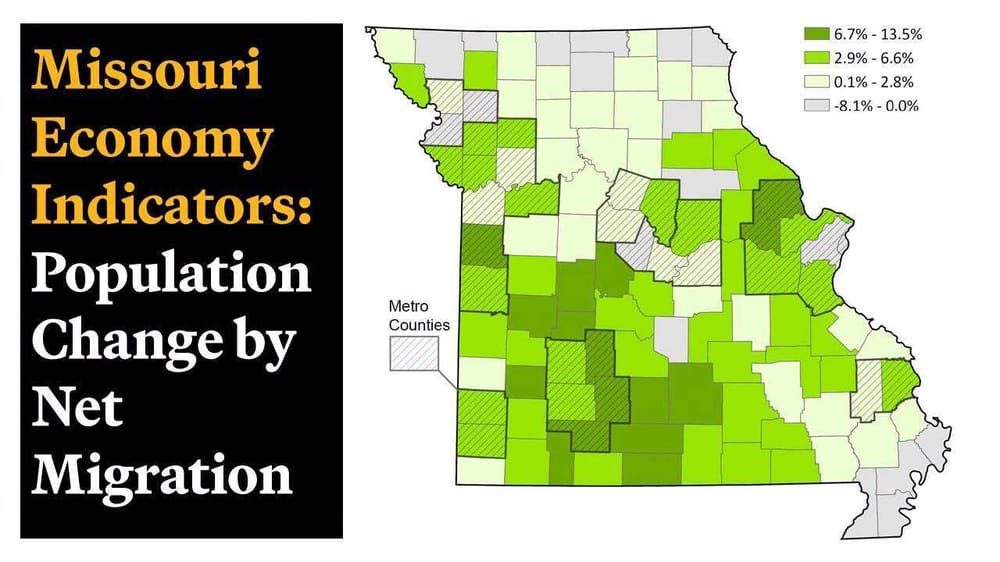
Missouri’s population gains and losses from net migration have become a central question for communities from St. Louis to Columbia, especially as employers and local governments plan for housing, transit, schools, and labor needs. Net migration is the difference between people moving into the state and people leaving it, after accounting for international immigration and domestic moves. In recent years, national patterns have shown that migration flows can shift quickly, tied to job markets, housing costs, and where new employment is expanding.
This matters in Central Missouri because net migration is a measurable driver of demand. When more people move into Missouri than leave, the effects typically show up in home sales and rentals, retail foot traffic, and the need for staffing in child care, health care, and public schools. When the trend reverses, local vacancy rates, budget forecasts, and workforce pipelines can tighten.
Net migration is shaped by domestic moves
Most of the movement between states is “domestic migration,” meaning people changing residence within the United States. The U.S. Census Bureau tracks this through migration estimates that reflect where people move for work, family, and lifestyle reasons. Separate federal data also track internal migration patterns through IRS tax return address changes, which offers another window into where people move and when.
For Missouri, the direction and size of net migration can be checked year by year using these official datasets. These sources also allow comparisons to neighboring states such as Kansas, Illinois, Iowa, and Arkansas, which often face similar cost pressures and job-market changes.
National context: migration responds to job and housing costs
At the national level, migration patterns have been influenced by shifts in employment locations, remote work trends, and uneven regional recovery from the pandemic era. In plain terms, people often move toward areas offering employment growth and attainable housing, while others leave places where rents and home prices rise faster than incomes.
Because these factors operate at the national scale, Missouri readers are likely to see the same broad forces even when the state’s economy performs differently from the national average. The result is that net migration can move independently of short term statewide headlines like quarterly job growth.
Missouri net migration is lifting some counties, report says
People move every day for school, work, retirement and family, and those moves add up to measurable changes in local communities. A University of Missouri Extension report looking at net migration from 2020 to 2025 finds that migration helped increase population in the United States and, in Missouri, in both metro and nonmetro areas. The report notes that net migration from 2020 to 2025 raised the average U.S. county population by 2.5 percent. It also finds that Missouri counties gained an average of 2.1 percent of their population from net migration during the same period.
In Missouri, the report says the pattern differed by county type. Nonmetro counties saw larger gains than metro areas, with net migration contributing 2.8 percent of population growth in nonmetro counties, compared with 1.8 percent in metro areas. The report also highlights that some counties saw especially large increases, including Lincoln, Hickory, Benton and Ozark County, though the exact magnitudes are not included in the text you provided.
When planning for what comes next, the report also identifies differences in how newcomers may prioritize community needs. It says while all residents value community ties and health care access, newer residents place more emphasis on broadband access and on arts and outdoor recreation. Those priorities can shape local decisions, from where to expand service coverage to what amenities and programs communities highlight as they grow.
Local impact for Columbia and Central Missouri
If regional growth is fueled by net in migration, communities may see more demand for broadband and for recreation and cultural programming.
Shifts between metro and nonmetro counties can affect where employment and services expand within commuting range of Columbia.
Local governments and organizations may need to plan for the timing of demand, including housing, school enrollment trends, and service capacity.
What to watch next in Missouri
As Missouri and local regions plan for the coming years, the most practical takeaway is timing. Net migration affects school enrollment, housing construction pipelines, and staffing demand with a lag. Readers should also watch how migration trends line up with state labor force data, housing affordability indicators, and economic development announcements, since those signals help explain whether migration is likely to strengthen or weaken.
Local impact for Columbia and Central Missouri
Housing demand and prices: Net in migration can increase competition for rentals and homes, especially near employment hubs.
School planning: Changes in migration often show up in enrollment needs for districts serving Columbia and nearby communities.
Workforce supply: More newcomers can ease hiring in sectors like health care, education, and construction, while out migration can do the opposite.

Hi, I Am Cub Reporter
CEO Of
573 Local
What's Up in Columbia
Welcome to What's Up in Columbia, Mo is about Local Events, Deals, Things to Do and Business.

Subscribe to our Weekly Newsletter
You just read about this...
Super excited about getting local events every week? We are, too!
Have you ever missed an event? Get access to local events, discounts and savings